

So far this half-term I’ve spent more time out and about in classrooms and less time in the office; always a good thing in my opinion! I’m sometimes guilty of hibernating myself away over the dark winter months, but as soon as February rolls around, I get itchy feet. Anyway, teaching block-based coding to a Year 6 class every Monday morning at Mary Swanwick Primary over the course of the last few weeks has reminded me of something simple but pretty powerful: children learn best when they DO something long before they can fully explain it.
I know it sounds a little confusing, but across multiple sessions, I once again watched a group of 10–11 year olds move from uncertainty to confidence, from “I don’t get this” to “Look what I made!” And the journey they took wasn’t accidental, but instead shaped by a deliberate approach built around hands-on exploration, guided questioning, and something my former colleague, Rosie, introduced me to…The Learning Pit by James Nottingham. This teaching concept and others like it are so heavily embedded in our ComputerXplorers sessions and wider curriculum, so much so, I often forget they are there.
I’ve been teaching computing for such a long time now, I often find myself running on auto-pilot. So, unless I’m forced to stop and think, I don’t notice what’s happening. Luckily for me, when teaching our MakeCode Arcade Game Building and Coding course at Mary Swanwick Primary, I had the benefit of being observed by two trainee teachers. This always makes me analyse my own practice and gives me the desire to self-reflect on what is happening in the classroom.
The Power of The Learning Pit in the ComputerXplorers curriculum.
Oh yes. The Learning Pit. It goes a little like this:-
- Start with a new concept (like loops or variables) but deliberately do not give them the full explanation.
- Explore though questioning..“What do you think this block might do?”…“What would happen if we changed this number?” The goal isn’t to get the right answer immediately, but to get them thinking.
- Once they had wrestled with the idea, move into practical tasks. These are small, focused challenges designed to reveal the concept through doing. Like building a skiing game with a ‘score’ and ‘lives’. Let them work it out as best they can using printed resources and each other as a support network.
- Reflect at the top of the Pit and compare this to the anwers they gave at the start of the lesson. At the end of each lesson, we reviewed:
- “What didn’t you understand at the start?”
- “What changed?”
- “What can you do now that you couldn’t do before?”
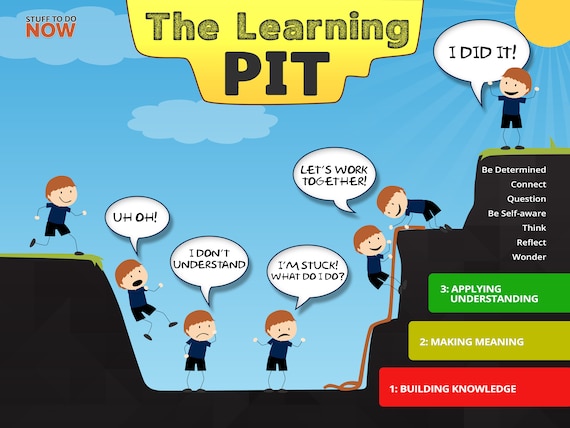
In my opinion, seeing their own progress makes the learning feel real.
Teaching classes using technology works well due to the feedback loops you get from using a computer that you can’t get from a worksheet and peers alone. In simple terms, if you click a button and it doesn’t do what you need it to, you can click other buttons until you get the desired outcome. Actually, kids are often better than adults when it comes to having the resilience to work things out on an electronic device.
Block-based coding gives children a safe, visual way to experiment with logic, sequencing, and problem-solving. But the real magic happens when they’re encouraged to try something before they fully understand it.
Let them build first, then explain the theory afterwards.
This approach works because:
- Children develop intuition through play.
- They spot patterns naturally when they’re hands-on.
- They become more confident taking risks.
- They learn to debug by exploring and not by memorising rules.
Watching Understanding Evolve Over Time
When teaching ComputerXplorers STEM sessions, I see the same pattern repeat itself:
- Initial confusion
- Exploration
- Experimentation
- Breakthrough
- Confidence!
By the final week, pupils who once hesitated to drag a block into the workspace were confidently building multi-step scripts, debugging their own errors, and explaining concepts to each other.
One of my favourite moments this half-term was hearing a student say, “I didn’t get variables at all at the start, but now I use them without really thinking about it.” That’s the Learning Pit in action.
Why ComputerXplorer’s Approach To Teaching Coding and STEM Works.
This blend of hands-on learning, guided questioning, and structured reflection works because it mirrors how real programmers learn. Coding is not a subject you memorise, it’s a subject you experience. In my days as a professional web developer, some of the best coders I worked with were all originally “self-taught” by getting hands-on.
Learning in that fashion helps children especially because they:-
- Build resilience
- Develop problem-solving skills
- Understand concepts more deeply
- Feel proud of their progress
- Become independent learners
Most importantly, it helps them see themselves as capable creators, not just passive consumers of technology.
Teaching block-based coding to Year 6 this half term has reinforced something I’ve always believed: when children are given space to explore, struggle, question, and create, they learn far more than they would from a perfectly polished explanation. At ComputerXplorers we use pedagogical techniques like the Learning Pit all the time, which is just one of the reasons why our curriculum is revered by both children and parents alike.

